
(My Client Called Me Out)
Every Monday in the Accountability Club, we meet to review the work completed the previous week and to set our tasks for the coming one. We use the tools I’ve created as part of the Momentum Strategic Planning System.
During one particular Monday meeting, my client called me out.
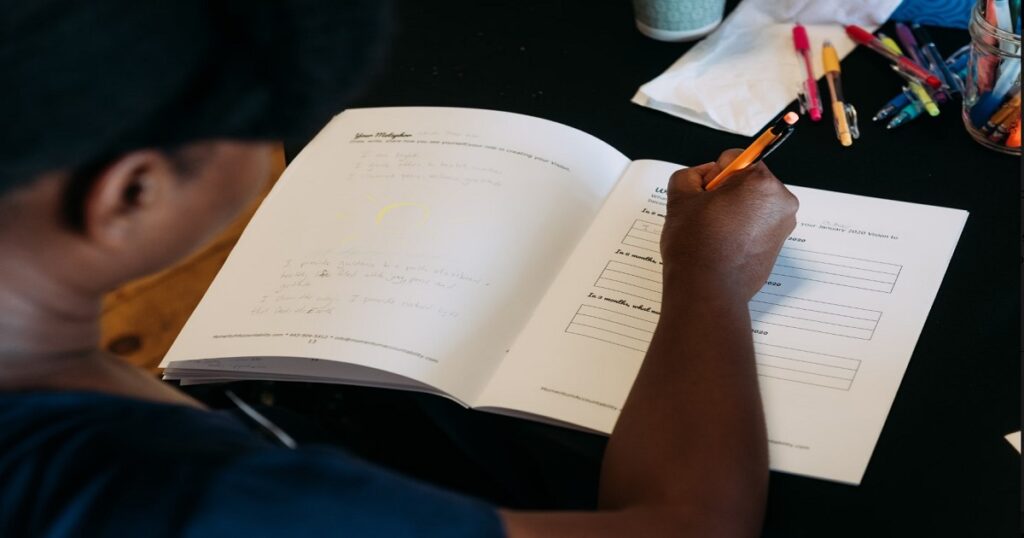
She was using the Daily Vision Action Planner with great success and wanted to know if I had completed mine for the day.
It was a fair question. After all, shouldn’t the coach use her own tools?
In that moment, I hung my head in shame. I hadn’t used the planner in weeks. Although I knew it worked—I had proof from my own results and from my clients—I had stopped using it.
Later that morning, I printed out five copies and recommitted to the daily visioning and planning process the tool supports. As expected, it worked beautifully once again.
The Question That Haunts Every System Creator
Here’s the question that keeps me up at night: Why do we stop using the systems that work?
Perhaps it’s because we love creating new systems but dislike the routine of staying consistent. Or maybe we simply forget what we committed to and keep reinventing the wheel.
Another possibility is what Gay Hendricks describes in The Big Leap—an “Upper Limit Problem.” We get uncomfortable with success and unconsciously sabotage our progress.
Finally, once a system works, we may forget that it was the system that produced the results. It’s like when people stop taking their medication because they feel better.
The Pattern Repeats Itself
Last spring, another client built a system to plan and record six months of videos in just 30 days. Since she was starting from scratch, it took her about two and a half months to develop and implement everything. It was a lot of work.
A month later, she mentioned that she wanted to create a new plan for her content. She had already forgotten the months of effort she invested in building the first system. She had also forgotten that she planned to reuse it in the fall.
Fortunately, I reminded her. (That’s what I do!) After our conversation, she agreed to re-run her six-month-in-30-day video creation system one more time. I promised that it wouldn’t take 2.5 months this round—and I was right.
Because when a system works, the smartest and most efficient thing to do is to use it again.
The Boredom Trap
Recently, I was listening to Gina Knox’s podcast Small Business, Big Money, and she made a great point. She said that being bored with your system is not a reason to stop using it.
If your process works, keep using it. Instead of changing your system, find excitement somewhere else.
In fact, you don’t always need to analyze why you stopped using something that works. Sometimes, you just need to return to it.
If you’ve already designed a system that fits your time, resources, and needs, then it’s not a systems problem—it’s a consistency problem.
The Simple Solution
So, how can you make it easy to follow your system?
- Set a daily alarm reminder.
- Add a sticker chart to track your progress. (They work for adults, too.)
- Create a checklist that lists your daily systems.
- Or adopt a mantra like: “My system works when I work it.”
Each of these simple steps helps you stay consistent. Moreover, they make it harder to forget what’s already working.
Your Turn to Get Back on Track
Now it’s your turn. Pick one idea and take action today. Pick up your system and get those results you already know are possible.
Remember, the magic isn’t in constantly creating new systems—it’s in working the one that already proves itself. Your past success is the best predictor of your future results, but only if you keep showing up for the system that created that success.
So, what system have you abandoned that you know worked? What’s one step you can take today to return to it?
The difference between those who reach their goals and those who don’t isn’t the complexity of their systems—it’s their willingness to stay consistent. Even when it feels ordinary. Even when it’s no longer shiny or new.
Your breakthrough is waiting on the other side of consistency. Are you ready to claim it?
Ready to get back on track with systems that work?
[Book a Strategy Session] to create accountability structures that keep you consistent with what matters most—because the right system only works if you work it.