
By Nettie Owens, CPO-CD · The Sappari Group
Originally explored on Wake Up Women Leaders — Episode 9
You have a vision for what your organization could look like. The events, the reach, the programs, the team. And then you look at what you have in the bank – and the gap between those two things feels like it has no bottom.
You may be inclined to shrink the vision. Make it more manageable. Scale it back to something the current budget can actually support. That move feels responsible. It is not. It is the wrong call – and in Episode 9 of Wake Up Women Leaders, Victoria Whitfield and I made the case for why big vision on a small budget is not just possible, it is the better starting point.
The Budget Is Not the Ceiling
When women leaders building organizations talk about budget constraints, the conversation usually goes one of two directions. Either the vision gets cut down to fit the money available, or the leader decides to wait – to pursue the big vision once the budget catches up. Both directions lead to the same place: no interia.
Victoria put it plainly:
“The vision’s the north star. It’s the magnetic north that pulls you in the direction of where you want to go. So if you shrink it, you’re not going to be really headed towards what you’re capable of. You will shrink your output if you move the goal post back.”
The budget is a constraint. That is different from a ceiling. A constraint gives you a container to operate in – it forces clarity, prioritization, and creativity. A ceiling stops you. The distinction matters because the leaders who build well on limited resources do so because of the constraint, not in spite of it.
Every constraint – whether it’s budget, time, or resources – is an opportunity to innovate and find a path forward you wouldn’t have discovered otherwise. That’s why the obstacle is the way, not the roadblock.
When women leaders building organizations treat the budget as a ceiling, they stop asking, “How can I?” When they treat it as a constraint, they start solving problems.
Victoria did a world tour in under a year with no real budget to speak of. Not a 50-city tour. Not Beyoncé-level productions. Seven stops, all funded through resourcefulness and relationship – and at the end of every single visit, people asked when she was coming back. The vision was intact. The budget just shaped how she got there.
“The vision may be 600 pounds,” she said, using a powerlifting analogy, “but it’s okay for you to start at six. You get stronger on the way.”
Why More Money Is Not Always the Answer
There is a strong case to be made that having too much money too early is a genuine risk.
The EIDL loans distributed during COVID are the clearest example I have seen in recent years. That money was made available to help small businesses survive, and from every person I have spoken to who took one, the outcome was not what they hoped. The money came in without structure, without a clear plan for how it would generate more money, and without the constraint that forces good decision-making. The result, in most cases, was more debt – often twice as much as the original loan.
The constraint was gone, and so was the discipline it creates.
“Without the constraint, without that container to operate in, it was spent. More people became twice as much in debt as the loan that they took at a minimum.”
Women leaders building organizations who are working with a tight budget have an advantage they often do not recognize: they are forced to know where every dollar is going and what it is supposed to produce. That discipline does not disappear when the budget grows. It compounds.
Where to Invest First
The practical question – which came up directly in our conversation – is where to put limited resources when you cannot cover everything. The answer is not systems, not visibility, and not ad spend.
It is people. But not in the way most leaders think about it.
Victoria was clear: do not hire people. Do not outsource your decision-making and creativity to a team that does not know your vision. Instead, build relationships. Find the people who have what you need – a venue, an audience, an expertise, a network – and figure out how to work together.
“Be down with other people’s payments. If they want to be the host in the space, or if they want to bring in their friends, if they want to co-sponsor the event – be down with OPP. Bring in the community around you.”
The potluck analogy is the most practical version of this: if you want to throw a great dinner party and you do not have the budget to fund the whole thing yourself, make it a potluck. People bring what they have. You end up with more than you could have created alone – and often better than what you would have bought with a full budget.
This is not a small-business workaround. Larger organizations do this constantly. Self-driving vehicle companies are not building cars from scratch. They are building on existing technology, through partnerships with Ford and Toyota, layering their specific innovation on top of infrastructure that already exists. The vision is theirs. The path to it runs through relationships.
It’s Actually A Sales Problem (Sort of)
For many women leaders building organizations, the budget constraint is real – but the deeper issue is that they have not yet learned to make money consistently, or they are not comfortable receiving it.
Victoria said it directly:
“You are forbidden from spending money until you make money. Forbidden.” Because…
“Spending money doesn’t make money.”
This is not a popular statement in an era where every business guru is selling a course, a launch strategy, or a branding package. But the math is simple. If you have not yet built a reliable way to bring money in, putting money out does not fix that. It accelerates the problem.
The first investment for women leaders building organizations from scratch is not a website, not a team, not a system, and not an ad budget. It is the skill of asking for the sale, getting paid, and doing it again. Everything else gets built on top of that foundation – and without it, no amount of budget will produce what you’re after.
We talked about this dynamic in depth in Don’t Starve Your Business – because underpricing and underinvesting will sabotage even the biggest vision, no matter how much passion you bring to it.
“So many women leaders are asleep at the wheel when it comes to sales,”
Victoria said. She is right. And the leaders who close that gap earliest are the ones who scale fastest, not because they had more money, but because they built the muscle.
The Iterative Path Forward
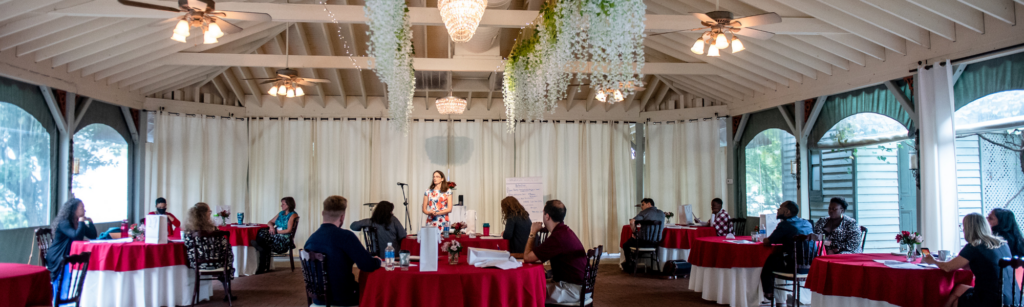
One of the clearest examples I shared in this episode was my own event, Momentum Live. I had a vision for what that event looked like – a beautifully branded, well-appointed experience. I did not have the budget for it. So I made one decision: every time I hosted the event, I would add one more branded item. One time it was flags. One time it was a pop-up display. The next was table top displays. But every iteration was one step closer – and every attendee saw it getting better.
That is the model. Not the full vision all at once. The next step toward it, executed well, on budget, right now.
Women leaders building organizations who are waiting to pursue the vision until the budget is right are waiting for a condition that does not arrive on its own. The budget follows the work. The work follows the vision. The vision has to stay intact – big, clear, specific – even when the resources available today are small.
As I said at the close of the episode: “Dream big, ladies. It is 100% possible and diminishing your vision will never make it better.”
Four Places to Start This Week
- Write the full vision down. Do not edit it for budget. Get the complete picture on paper first – then figure out what the first step is.
- Identify your highest-leverage relationship. Who in your network has something you need – a venue, an audience, a platform, a skill? Start there before you open your wallet.
- Make one sale. If you have not yet established a consistent way to bring money in, that is the work this week. Not the brand refresh, not the content calendar, not the tech stack. One sale.
- Add one thing. If you are building toward a bigger vision with an existing event or program, decide what the one next addition is. Just one. Budget for it, execute it, and move to the next one.
What’s Coming Next
In Episode 10, Victoria and I are taking this conversation further – because if the budget conversation is really honest, it comes down to whether you believe the investment in yourself is worth making. We are calling it Screw Bootstraps – We Want Stilettos. The Case for Investing in Yourself. Join us Wednesday at 3:30pm ET.
READY TO KEEP GROWING?
Explore how to create success systems that honor your unique journey and expertise.
Subscribe to The Weekly Reset, where I share research, ideas, and strategies for leaders navigating the complexities of sustained impact.
Join the Accountability Club — support designed for strategic planning, implementation, and growth with a monthly peer mastermind for meaningful connection and ongoing strategic support.
If you’re looking for a personalized partnership to create space, a plan, and focus in your leadership, let’s talk. I offer Private Executive Coaching for executives and entrepreneurs ready to move from overwhelmed to clear, from scattered to focused.
Send me a message, I’d love to explore how we can support your continued growth.
Nettie Owens, CPO-CD · The Sappari Group · sapparigroup.com · © 2026